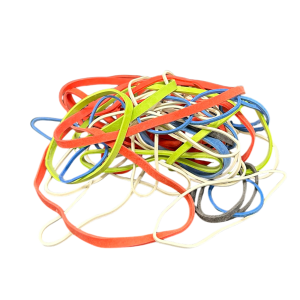
Rubber bands are one of those products that look simple but play a crucial role in packaging, logistics, and everyday organisation. Read our rubber band size guide as choosing the wrong size can lead to waste, snapped bands, or even damage to your products.
At Icon Flexpack, we’ve helped businesses across the UK find the perfect rubber band for their specific applications, from small packaging firms to large-scale warehouse operations.
This guide will walk you through everything you need to know about rubber band sizes, stretch factors, materials, and the best options for your industry.
Why Our Rubber Band Size Guide Matters
Rubber bands are designed to hold things together. If they are too small, they can snap or distort the items they are securing. If they are too large, they won’t grip properly, and items can slip out.
For industrial and commercial use, getting the size right is about more than convenience. It’s about efficiency, safety, and cost control.
This rubber band size guide and our bespoke rubber band service exists for this very reason.
Some businesses require standard bands in bulk, while others need made-to-measure bands for specific applications.
The Three Key Rubber Band Measurements
When you’re looking at rubber band sizes, there are three measurements to understand:
- Length – Measured as half the circumference when the band is laid flat.
- Example: A band that is 50mm long lies flat and has a circumference of 100mm.
- Width – The distance across the band when it’s laid flat.
- Narrow bands are more flexible. Wide bands provide stronger holding power.
- Thickness – The wall of the band.
- Thicker bands are stronger and last longer, but stretch less.
These three measurements combined determine the performance of a band.
You can explore our standard rubber bands for a sense of the common sizes available.
Understanding Stretch and Tension with our Rubber Band Size Guide
Rubber bands are elastic, but not infinitely so. On average, a good-quality band will stretch up to three times its original length.
- For best performance, aim for a band that will be stretched to about twice its resting length when in use.
- That way, you get reliable holding power without over-stressing the rubber.
Example scenarios:
- Office or stationery use – Light tension is enough. Standard bands will do the job.
- Warehouse pallet bundling – Heavy-duty pallet bands with high tension are required to keep loads safe.
Choosing the proper tension reduces waste from broken bands and improves safety for your team.
Matching Rubber Bands to Applications
Different industries and tasks require different types of bands. Continue reading our rubber band size guide for a breakdown:
Food Industry
Use food-safe rubber bands that comply with hygiene standards. These are commonly used in bakeries, meatpacking, and the fresh produce industry.
Logistics and Warehousing
Heavy-duty pallet bands are the safest option for securing goods during transport and storage. They reduce the need for plastic shrink wrap, making them a cost-effective and eco-friendly choice.
Medical or Allergen-Sensitive Environments
Our latex-free rubber bands are ideal where allergies are a concern. These bands provide the same performance without the risk of latex exposure.
General Use
Our standard rubber bands cover a wide range of applications, from office supplies to craft projects. Available in multiple sizes and colours, they are versatile for day-to-day needs.
Longevity: How to Make Rubber Bands Last
Even the best-quality bands can wear out if stored incorrectly. To extend their life:
- Store them in a cool, dry place.
- Keep them out of direct sunlight to avoid UV damage.
- Avoid exposure to oils, solvents, or high heat.
- Use sealed packaging for long-term bulk storage.
Businesses that order in large quantities often ask about packaging options. Our bespoke rubber band service can recommend the best way to package your order for long-term storage.
Testing Before You Commit
If you’re unsure which band is right, consider ordering a trial batch. We regularly supply samples for businesses that want to test a few options before placing a bulk order.
This approach helps you avoid waste and ensures you get precisely what you need.
Common Mistakes to Avoid
- Overstretching – Bands that are too small are forced beyond their safe limit and snap.
- Wrong width – A narrow band may cut into soft packaging, while a wide band provides a smoother grip.
- Ignoring material – Using standard bands in food settings is a compliance risk.
- Bulk buying without storage planning – Bands deteriorate if left in heat or sunlight.
Quick Rubber Band Size Guide
Here’s a simple reference to help:
- Small items (letters, stationery, crafts) – Narrow bands, 50–70mm length.
- Medium items (bundling boxes, parcels) – Medium width, 100–150mm length.
- Large/industrial (pallets, crates, bulk packaging) – Wide, thick pallet bands 500mm+.
If in doubt, contact us and we’ll recommend the right fit.
FAQs
How do I measure for a rubber band?
Lay the item flat, measure its circumference, and choose a band that stretches to twice its length around that size.
Are wider bands always stronger?
Wider bands distribute pressure more effectively, but thickness also plays a significant role in strength.
Can I order custom colours or printed bands?
Yes, our bespoke service can produce custom colours, printing, and sizes to suit your brand.
What’s the shelf life of rubber bands?
Stored correctly, most bands last 1–2 years. Food-safe bands may have shorter recommended shelf lives for compliance reasons.
Final Thoughts
Choosing the proper rubber band size involves balancing length, width, thickness, and material with the specific job you need to accomplish. The right choice saves money, prevents waste, and ensures safety.
At Icon Flexpack, we supply everything from standard rubber bands to heavy-duty pallet bands and offer a complete bespoke rubber band service.
To ensure you order the proper size, please speak with our team today, and we’ll guide you in the right direction.